


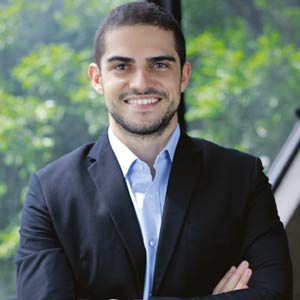
Gustavo Souza
In an interview with StartupCity, Gustavo Souza, Managing Partner at SaaSholic, discusses the startup landscape in the Brazilian market and shares his insights into building thriving businesses even in adverse economies.
Gustavo Souza is a managing partner at SaaSholic, one of the premier venture capital providers for tech startups in Latin America. He has accumulated extensive experience from his time at companies like Rock Content, which he uses to guide and nurture businesses under his wing.
Pull Quote: “Brazil's robust economy and population provide ample opportunities for startups to grow, even without international expansion.”
Can you tell us about your background and journey to becoming a managing partner at SaaSholic?
My career began in law; however, different opportunities beckoned me to pursue the entrepreneurial path. My time at Rock Content, a content marketing company, equipped me with all the right skills to become a leader.
As a sales team member, I steadily grew through the ranks and ended up starting a new outbound customer-prospecting channel. With proper planning and execution, this team scaled to over a dozen members and became more effective and efficient than the traditional sales channels. The role at Rock Content swiftly evolved into corporate development, business development, investor relations, and finally, in the last two years of my tenure, as a general manager.
Responsibilities during this period included spearheading the acquisition of an American competitor and managing a substantial portion of our combined company's revenue. The hands-on experience gained at Rock Content gave crucial insights into the challenges faced by startups and served as the primary learning ground for my future role as a venture capitalist (VC).
As an angel investor and a sales specialist, many startup founders reached out to me for help optimizing their sales strategies and operations. I gained more connections, which translated into increased business momentum and paved the way for new deals. This phase ran parallel to my role at Rock Content, helping me build entrepreneurial and organizational knowledge, which is invaluable in my current role at SaaSholic.
What are some distinct points of view and expectations for investors and founders in Brazil's startup ecosystem compared to other markets?
Capital scarcity is the Brazilian market’s most prominent challenge compared to developed and mature counterparts like Europe or the U.S. This is also a blessing in disguise, as the environment incentivizes startups that generate immediate returns since multiple funding rounds may not be a viable option.
Brazilian startups have adapted to this paradigm by focusing on initiatives that guarantee higher ROIs, which is an attractive factor for investors.
Another particularity of the region is the size of exits. Brazil, compared to other countries, typically sees smaller exit transactions than developed countries. Despite not having a large number of unicorn exits, Brazil remains an attractive investment market for investors who calibrate strategies and funds on companies that can achieve hundred million dollar exits. The Brazilian market is under-invested, and the opportunities are plenty for the best investors.
Recently, the region has experienced rapid growth in talent density post-pandemic. Professionals experienced with global startups are returning to the domestic market, enriching it with new perspectives, strategies and best practices.
The size of this market also presents a distinct advantage, as startups can achieve profitability just by focusing on specific pain points inside the country. Brazil's robust economy and population provide ample opportunities for startups to grow, even without international expansion.
What trends do you foresee shaping Brazil's startup scene in the next 18 to 24 months?
At SaaSholic, we believe AI is bringing a paradigm shift in the market. But ground-level AI innovations are not expected from the country, as the major think tanks in that area are located elsewhere. Investors are focusing on applied AI technologies that can increase productivity and create value for customers.
Another recent trend is the scarcity of A, B and C funding rounds amid the rising interest rates. As we advance, we expect to see some normalization in interest rates and for the growth stage rounds to become more abundant and generous. In the meantime, we hope to keep investing in self-sustaining companies that grow despite the adverse economy. These companies view venture capital as an accelerant, not a primary fuel, positioning them well for future scalability as market conditions improve.
What would be your best advice for aspiring startup founders and investors?
A simple yet crucial advice is to avoid waiting and blaming market conditions. Leaders must prioritize self-reliant business models that can sustain them under adverse circumstances. Companies must embrace scrappiness and creativity to improve customer revenue rather than relying on VC funds for survival.
History shows that some of the world's best companies emerged during challenging times. The advantage lies in the fact that many competitors and aspiring founders shy away from the difficulties, waiting for more forgiving times. Remember, calm waters have never made a great sailor.
